PLC vs. DCS: Which Control System Is Right for Your Plant?
PLC or DCS? We break down the key differences, use cases, and how to choose the right control system architecture for your plant.
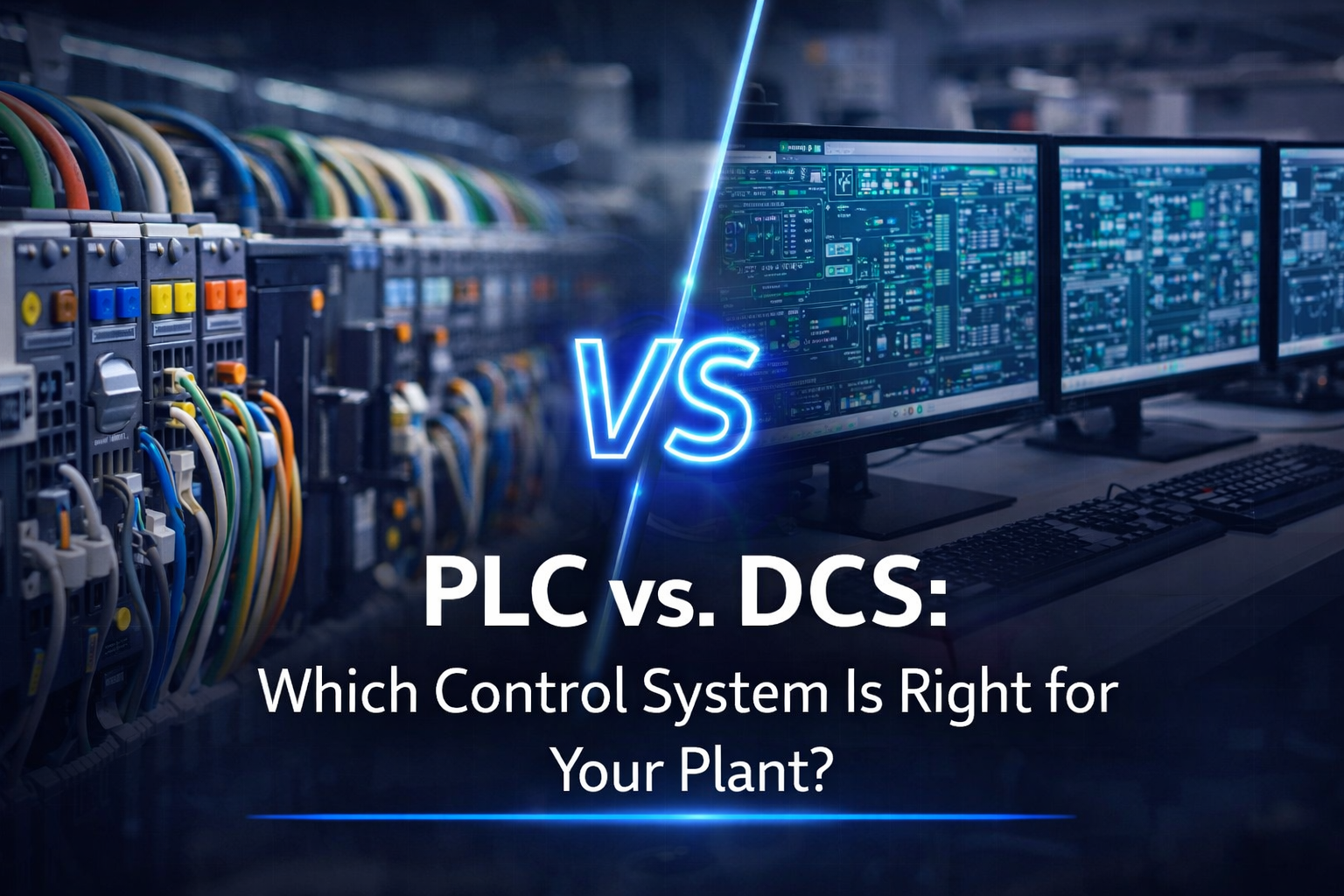

PLC vs. DCS: Which Control System Is Right for Your Plant?
We break down the key differences, use cases, and how to choose the right control system architecture for your plant.
If you're specifying a new control system — or upgrading an existing one — the PLC vs. DCS question will come up. Here's a clear breakdown.
PLC (Programmable Logic Controller)
Best for: discrete manufacturing, packaging, assembly lines, robotics.
PLCs excel at fast, sequential logic — turning motors on and off, reading sensors, controlling conveyors. They're modular, relatively low cost, and widely supported across all major industrial markets. A skilled automation engineer can program, troubleshoot, and expand a PLC system without vendor-specific training in most cases.
PLCs are also highly scalable at the low end — a small standalone machine can run on a single compact PLC, while a large assembly line can be controlled by a network of distributed PLCs communicating over Profinet or EtherNet/IP.
DCS (Distributed Control System)
Best for: continuous process industries — chemicals, oil & gas, water treatment, food & beverage at scale.
DCS architectures distribute control across multiple nodes, making them more resilient for processes that can never fully stop. They handle analogue process variables — temperature, pressure, flow, level — more naturally than PLCs, and their operator interfaces are typically designed around process overview rather than machine-level diagnostics.
DCS platforms from vendors like Honeywell, ABB, and Emerson also offer tighter integration with advanced process control (APC) and historian systems, which matters in regulated industries where data logging and audit trails are mandatory.
The Grey Area
Modern plants often need both. A chemical plant might use DCS for its reactors and PLC-based cells for its packaging line. Hybrid architectures — sometimes called "PLC + SCADA" — are increasingly common, and the line between the two technologies has blurred significantly over the past decade.
Modern PLCs from Siemens, Rockwell, and Beckhoff now handle process control tasks that once required a full DCS. Meanwhile, DCS platforms have adopted modular designs that look increasingly like PLC architectures.
The result is that most mid-to-large facilities today run hybrid systems — and that's not a compromise, it's a deliberate design choice. The key is to define your zones first, then specify the control architecture zone by zone.
When to Choose a Hybrid Architecture
A beverage plant, for example, might use a DCS for its brewing and fermentation tanks (continuous process, tight temperature control) and PLC-based cells for filling, capping, and labelling (discrete, high-speed, sequential).
The same logic applies in automotive, pharmaceutical, and food processing — anywhere you have a mix of continuous and discrete operations on the same site.
Total Cost of Ownership: What Engineers Often Miss
Upfront hardware cost is rarely the biggest number. When evaluating PLC vs. DCS, factor in:
Engineering time — DCS projects typically require more specialist programming hours, and that cost adds up quickly on large projects.
Licensing — Many DCS platforms charge per I/O point or per tag. At scale, this can exceed the hardware cost itself.
Spare parts — PLCs have broader market support. Proprietary DCS components can be expensive and slow to source, particularly for older platforms.
Upgrade cycles — How long will the vendor support this platform? Obsolescence is a real risk over a 15–20 year plant life. Always ask for the vendor's published end-of-life roadmap before committing.
Training — Your maintenance team needs to be able to work on the system. PLC skills are more widely available in the labour market than DCS specialist knowledge.
At KIPROM, we include a total cost of ownership analysis in every control system specification — so you're comparing real numbers, not just hardware quotes.
Migration: Upgrading from Legacy Systems
Many plants are not starting from scratch — they're running 15 or 20-year-old control systems that need to be modernised without shutting down production.
In these cases, the choice between PLC and DCS is often constrained by what's already in place. Migrating from a legacy DCS to a PLC-based architecture is possible, but it requires careful I/O mapping, signal conversion, and operator retraining. In many cases, a like-for-like DCS upgrade is faster and lower risk.
KIPROM has completed over 40 control system migrations across Europe and the Middle East. Our standard methodology includes a full I/O audit, a parallel-run testing phase, and a cutover plan that minimises production loss — typically to a single planned shutdown window.
Questions to Ask Before You Specify
Before choosing a platform, answer these:
- Is my process continuous, discrete, or both?
- How many I/O points do I need — and how will that grow in 5 years?
- Do I need redundancy at the controller level, the network level, or both?
- What SCADA or MES platform will sit above this system?
- Who will maintain this system — in-house engineers or a service partner?
- What is my vendor's 10-year support roadmap for this platform?
If you can answer all six clearly, the right architecture usually becomes obvious. If you can't, that's where KIPROM's pre-engineering assessment adds value — we help you define the requirements before touching the specification.
KIPROM's Recommendation
Don't start with the technology — start with the process. Define your cycle times, your I/O count, your redundancy requirements, and your budget. The right system follows from those constraints.
We work across all major platforms — Siemens, Rockwell, ABB, Honeywell, Emerson — and our recommendations are always process-first and vendor-neutral. Our engineering team can help you map requirements to architecture at no cost.
Conclusion
PLC and DCS are both mature, proven technologies. The question is never which is better — it's which is right for your specific process, scale, and operational context.
Ready to optimize your production line?
Get in touch with our team and find out how KIPROM can support your operations — wherever you are in the world.